I Gave My Stock Portfolio to a Team of AI Analysts. Here's the Report Card It Handed Back.
What if a whole desk of analysts looked over your shoulder for thirty seconds before every trade, and just told you what to do first?
Every retail investor knows the feeling.
You open your broker app. A dozen holdings stare back. A few are green, more are red, and honestly you have no idea if that's a portfolio or just a pile of tickers you bought on different Tuesdays for reasons you've long forgotten.
Should you cut the loser or average down? Is that big winner still winning, or quietly rolling over? Are your "diversified" stocks secretly the same bet wearing ten costumes?
Big desks answer this with a room full of specialists. The rest of us answer it with a WhatsApp group and a gut feeling.
So I built the room.
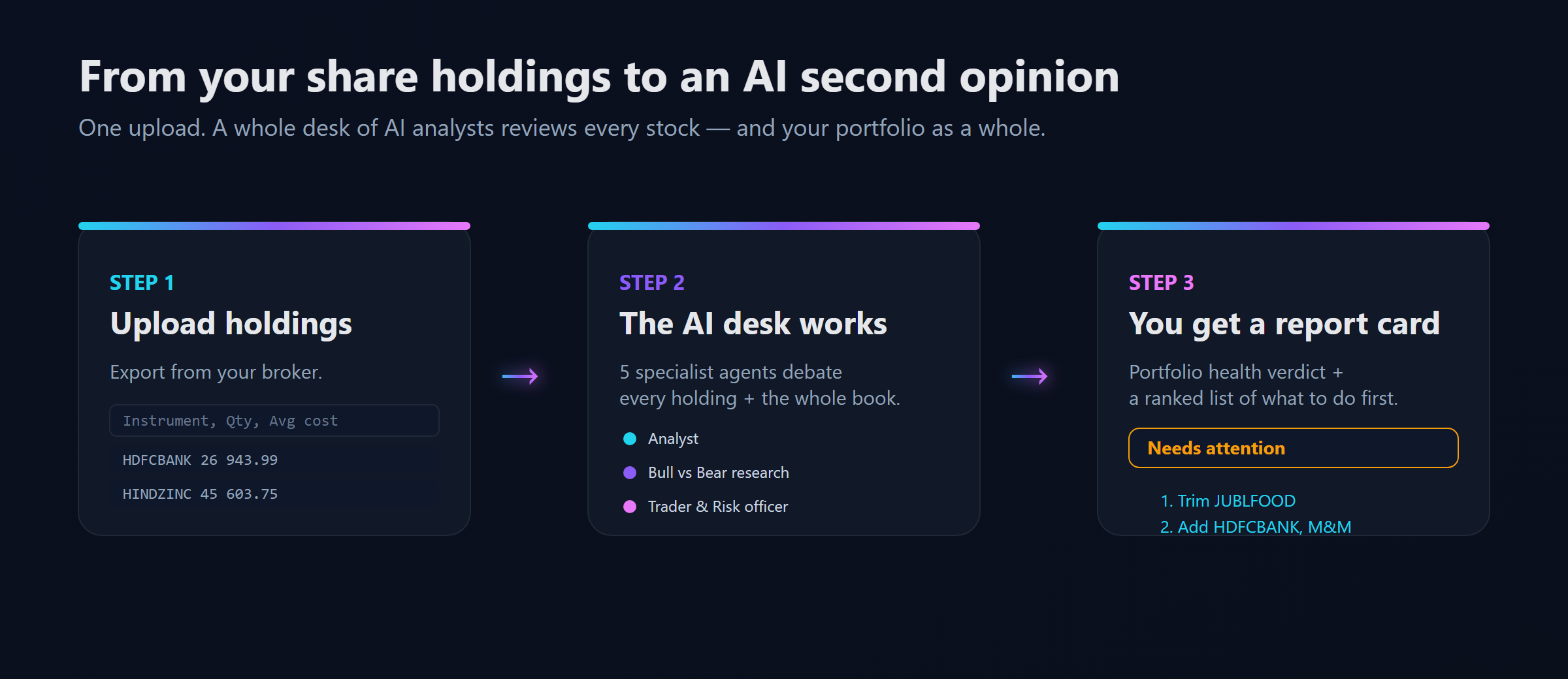
You upload your holdings, a team of AI agents reviews every stock and the portfolio as a whole, and you get back a report card that tells you what to do next. Built for Indian listed companies (NSE and BSE).
Quick note before we go further. Everything here is AI-generated, for educational and research purposes only. It is not investment advice, and I am not a SEBI-registered adviser. Models make mistakes, markets carry risk, and past performance guarantees nothing. Verify independently and talk to a registered adviser before you act. That same disclaimer travels with every report the tool produces.
Step 1: You hand it the mess#
No fancy setup. You drop in the holdings file you already have from your broker, pick a few settings, and hit analyze.
That's it. Everything after this is the machine doing an afternoon of junior-analyst work for every stock at once.
Step 2: Four specialists read every stock#
Here's the first idea that makes this more than a chatbot. No single number gets to decide.
A stock can look cheap and keep falling. It can look expensive and keep compounding. A great business at the wrong moment is still a bad trade. So four specialist agents each read the same stock a different way, and then an Orchestrator weighs all four and makes the call.
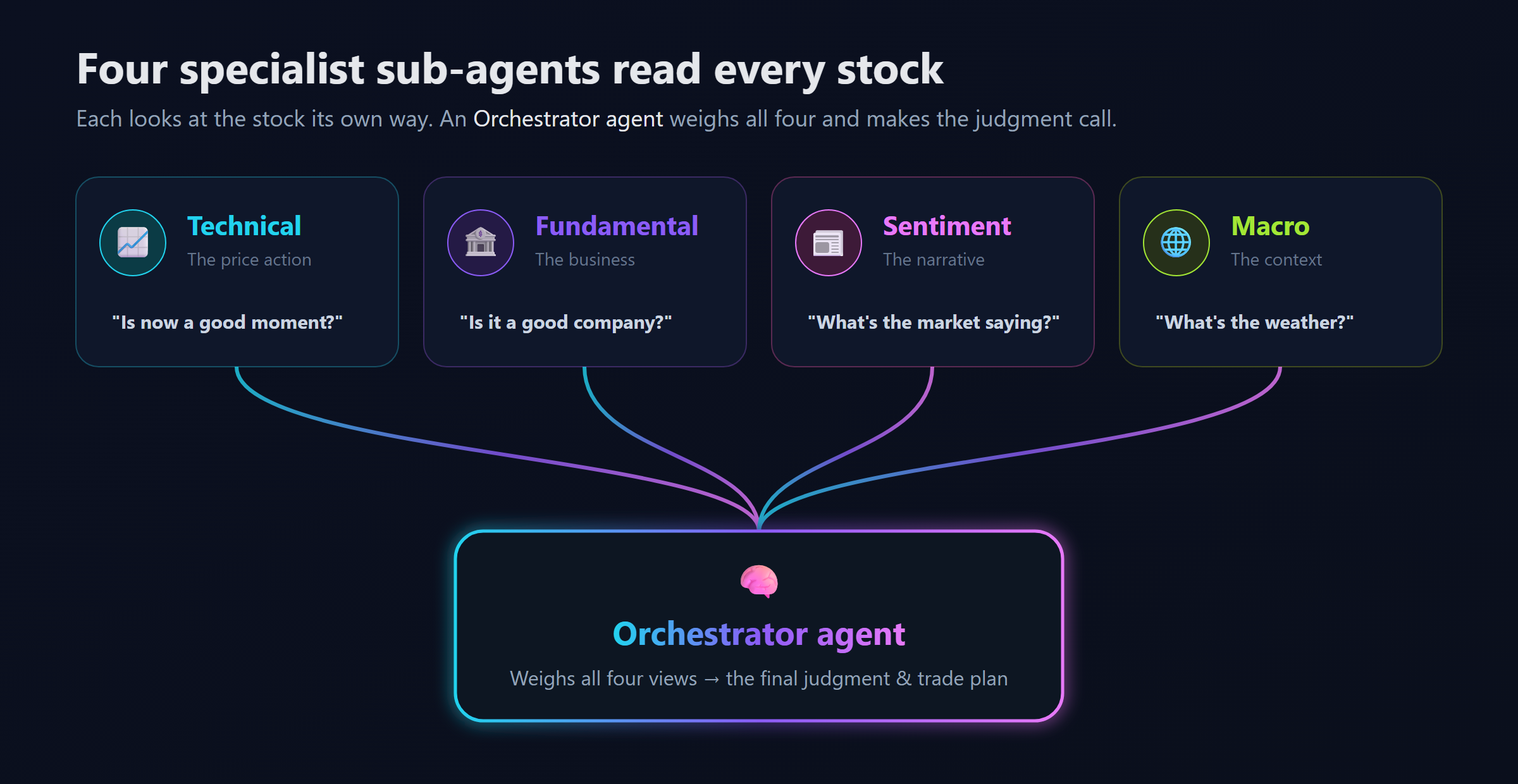
The point is what you get back. Not one gut reaction, but a verdict that already argued with itself. "Great company, slightly wrong moment, buy in stages" is a real position. A green arrow is not.
Step 3: A five-agent desk, not one opinion#
The specialists gather the view. The reasoning happens on a small desk of agents, each with one job, and they're built to disagree.
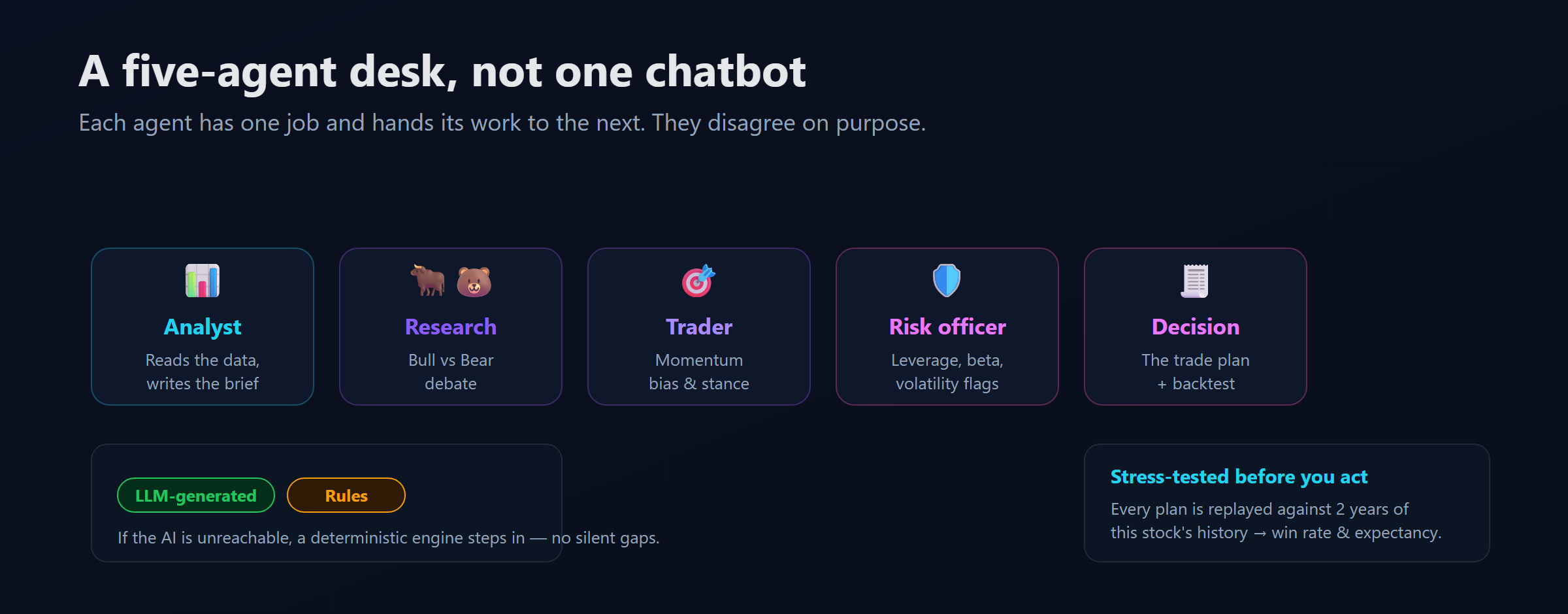
The part people love is the bull-versus-bear debate. One agent builds the strongest case to buy, the other the strongest case to run, and you get to read both. It's the argument you should be having with yourself and usually aren't.
Two things make this a tool instead of a toy:
It gets stress-tested before you act. Every plan is replayed against the last two years of that stock's own history, so "the AI says BUY" becomes "the AI says BUY, and here's how often that setup actually worked in this stock."
It's honest about itself. When the AI makes the call, it's badged green. If the AI is ever unreachable, a rules-based backup steps in and the plan is badged amber. You always know which one you're reading.
Three dials that change everything#
These aren't cosmetic. They rewire how the whole desk thinks.
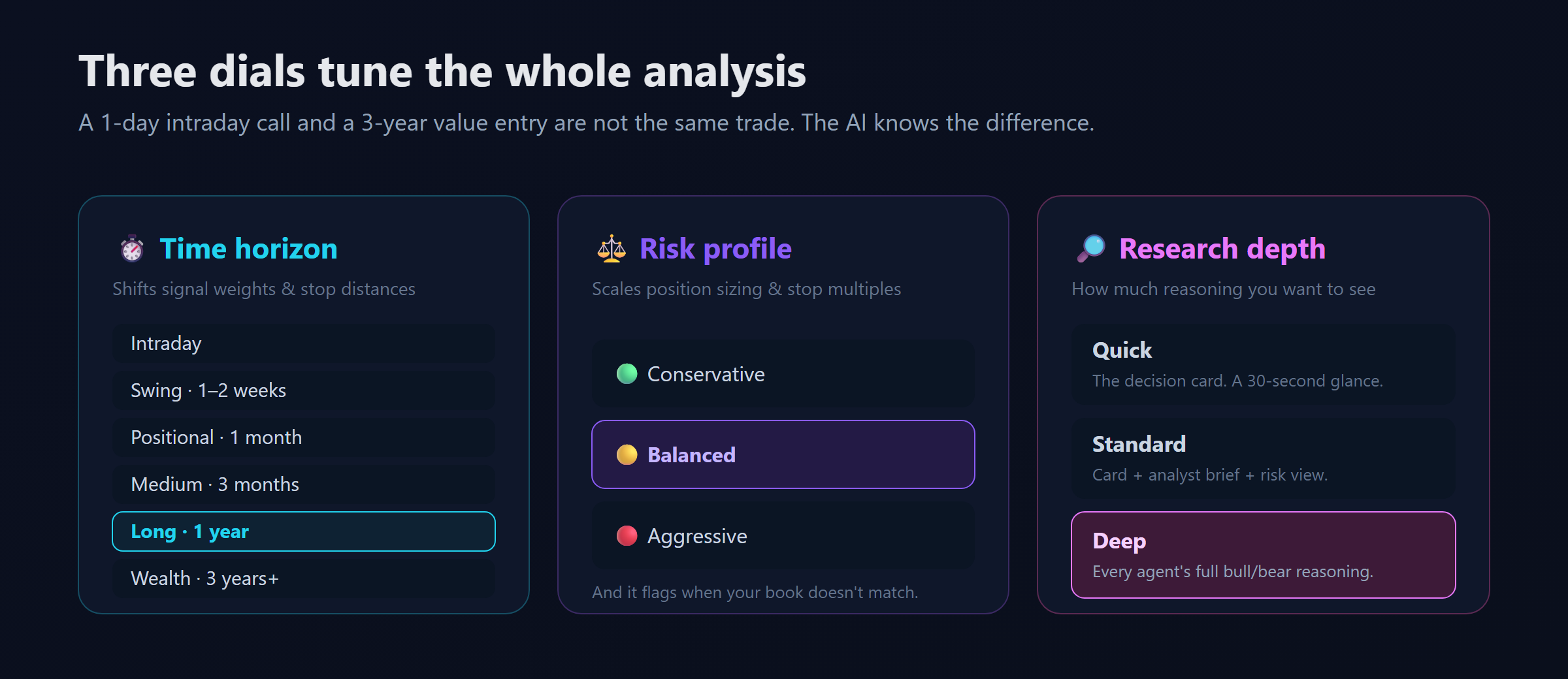
Pick your time horizon, from an intraday scalp to a three-year wealth hold. Pick your risk profile. Pick how deep you want to read, from a 30-second card to every agent's full reasoning. Same portfolio, three dials, and the answer is tuned to your timeframe and your stomach instead of some mythical average investor.
Oh, and if your actual portfolio doesn't match the risk appetite you claimed, it says so.
Then it zooms out, and this is the real magic#
Per-stock calls are useful, but the mistake most of us make isn't at the stock level. It's at the portfolio level. You can own ten good stocks and still be dangerously undiversified, quietly lagging the index, or carrying way more risk than you signed up for.
So after grading every holding, it steps back and looks at the whole book as one living thing.
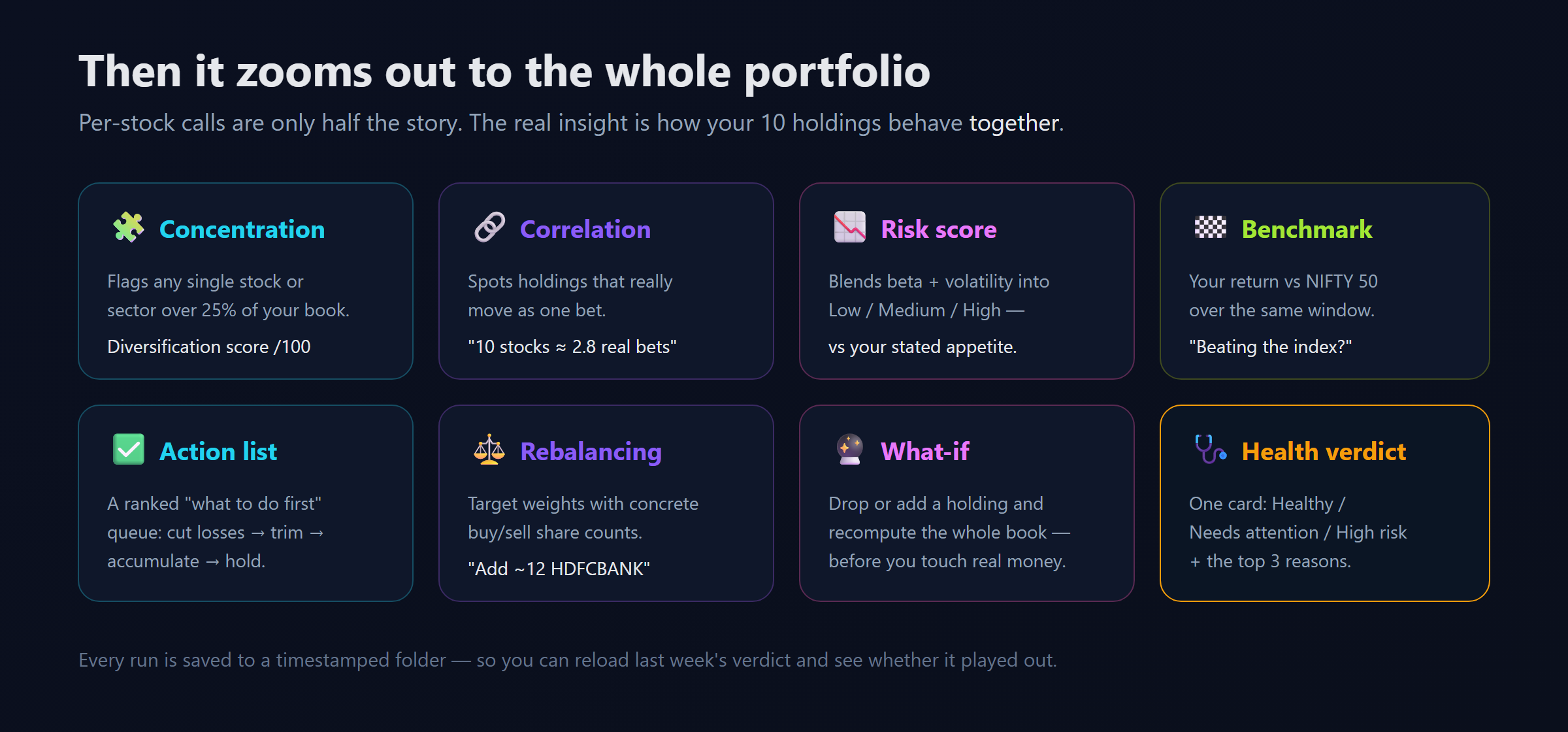
My favourite is correlation. It quietly tells you something like "your 10 stocks are really about 3 bets," which is the kind of thing you never notice until it hurts. Then it hands you a ranked list of what to do first, with actual share counts, not vague advice like "consider reducing tech."
And every run is saved, so you can pull up last month's verdict and honestly check whether it played out.
So what does the report card look like?#
Here's an illustrative example. Health verdict up top, the numbers, one stock's decision, and the "do this first" queue.

Look at what it refuses to do. It doesn't scream BUY or SELL. It says "you're beating the index, but a big chunk of your capital is under-working and sitting slightly in the red, and here are the four trades to fix it."
That's the whole point. Not a crystal ball. A senior second opinion for your entire portfolio, in the time it takes to make chai.
Why I built it this way#
I was tired of apps that spit out a confident green arrow and a price target from nowhere. Those feel like insight, which makes them worse than useless.
I wanted the opposite. Something that shows its reasoning, argues with itself, grades its own confidence, tests its plans against history, and admits when it's guessing. Something that makes me a more disciplined investor even on the days I disagree with it, especially those days, because it forces me to say why.
None of this replaces your judgment. It just makes sure your judgment actually heard the other side before you pressed the button.
The honest part#
This won't make you rich. It'll be wrong sometimes, occasionally with full confidence. Think of it as a very well-read intern who never sleeps, not an oracle. It's one input into a decision that stays yours.
But if you've ever stared at a screen full of red and green wishing someone experienced would just walk you through it for thirty seconds, that was the itch. Turns out a team of AI agents scratches it surprisingly well.
If this was useful, I write about building AI tools for everyday problems. Follow along, and tell me in the comments: what's the one question you wish your portfolio could answer for you?
Educational content only. Not investment advice. Not a recommendation to buy, sell, or hold any security. Talk to a SEBI-registered adviser before acting on anything here.
Written by
Niteen Badgujar
AI Engineer specializing in Agentic AI, LLMs, and production-grade machine learning systems on Azure. Writing to make complex AI concepts accessible and actionable.